The Butterfly Effect (2004): Logan Lerman, Sarah Widdows and the Childhood Scenes at the Film’s Core
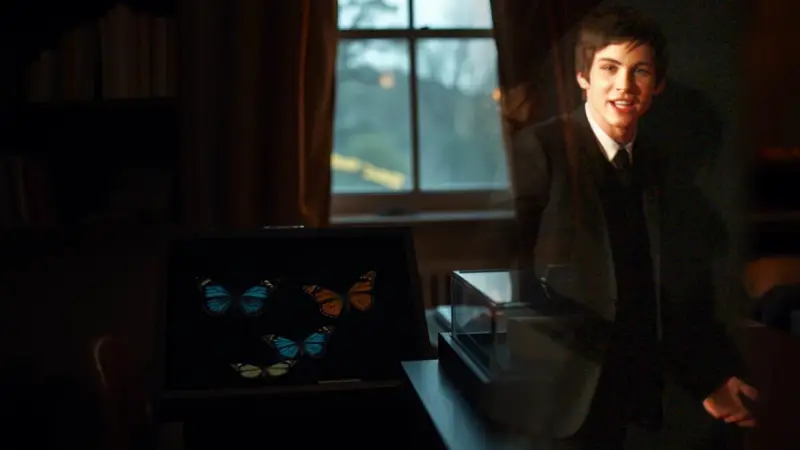
Half of The Butterfly Effect takes place in childhood. In the 2004 thriller, Logan Lerman plays Evan Treborn at 7 and Sarah Widdows plays Kayleigh Miller at 7. These younger versions of the central pair anchor everything the adult Evan, played by Ashton Kutcher, tries to rewrite. The film leans on flashbacks at ages 7 and 13, and it follows each attempt to change the past into a worse present.
Written and directed by Eric Bress and J. Mackye Gruber, the film is a bleak piece of mainstream science fiction. It was poorly reviewed, yet it was a hit with audiences. It has since become a cult favorite, and it is better remembered than many of the more polished thrillers of its year.
The premise: a diary as a time machine
Evan is a college student who has blacked out at key moments of his childhood. Reading the journals he kept as a coping mechanism, he finds he can return to those moments. His adult mind occupies his younger body, and he can change what happened. Each fix for himself and his friends, Kayleigh, her brother Tommy and Lenny, brings back a present that is different and often worse.
The childhood chapters carry the weight. The young Evan scenes with Lerman, and the Kayleigh scenes with Widdows, set up the bonds that the adult Evan is fighting for. Without them the later alternate timelines would be only a puzzle.
How it was made
Bress and Gruber first wrote the story as Blackouts. According to a 2024 retrospective in The Ringer, the first draft was so dark that their manager was disgusted, and they put it in a drawer. Two years later, producers J.C. Spink and Chris Bender read it, and Bender was struck by its ending. The writers then worked on the rules of the time travel, and one rewrite went too far toward romantic comedy before they returned to the original darkness.
A route to directing came through Final Destination 2. New Line executive Richard Brener liked their script and hired them to write that sequel. In 2002 the studio backed their own project on the condition that they land a major star. Kutcher, then known mostly for comedy, took the lead and also served as an executive producer. The shoot took place in Vancouver, with Matthew F. Leonetti as cinematographer. Michael Suby wrote the score and Peter Amundson edited.
The ensemble around Kutcher included Amy Smart as the adult Kayleigh, Elden Henson as Lenny Kagan, William Lee Scott as Tommy Miller, Eric Stoltz as George Miller, Melora Walters as Evan’s mother Andrea, and Ethan Suplee as Thumper. John Patrick Amedori played Evan at 13, with Irene Gorovaia and Jesse James as Kayleigh and Tommy at the same age.
The ending the studio changed
The film’s most discussed decision was its final scene. New Line grew nervous about the original conclusion and asked for alternatives. Four endings were shot. At test screenings the studio’s favorite, a romantic reunion, lost out to a quiet, ambiguous street encounter between Evan and Kayleigh, and that one was used in theaters. The original, much bleaker ending reached viewers months later on the director’s cut DVD. Bress and Gruber have said they were upset at the time but now see merit in both versions.
Reception and box office
Critics were mostly unkind. Rotten Tomatoes lists a 34% approval rating from 169 reviews, and Metacritic gives it 30 out of 100 from 35 reviews. Roger Ebert enjoyed it “up to a point”. He wrote that the constant jumping back and forth left him feeling “jerked around”, and he questioned how selectively the changes rippled outward. Others were kinder. The Florida Times-Union gave it three stars out of four and called it a solidly entertaining B-movie.
Audiences responded differently. The film opened at number one in the US, with about $17.1 million in its first weekend. It finished with roughly $96 million worldwide against a $13 million budget. CinemaScore audiences gave it a B+. It also won the Pegasus Audience Award at the Brussels International Fantastic Film Festival and was nominated for a Saturn Award for Best Science Fiction Film.
In a 2009 retrospective, The Guardian’s Peter Bradshaw wrote that critics, himself included, had been too harsh. He pointed to the disdain for Kutcher as a factor in making the film uncool to like.
Legacy and where to watch
Two sequels followed, both made for home video. The Butterfly Effect 2 arrived on October 10, 2006 and The Butterfly Effect 3: Revelations on March 31, 2009. Variety reported in July 2013 that a reboot had entered development.
The original has outlasted them. The Ringer’s 2024 piece argues that its extremes are what keep it in the collective memory. For Lerman, it was an early screen credit in a career that soon included the series Jack & Bobby (2004–2005).
As of September 2026, listings show the film streaming on Howdy via Amazon and available to rent or buy on Apple TV and Amazon Video. Availability changes often, so check before you plan a viewing.
More on HotFlick
Cast
FAQ
Who plays Evan as a child in The Butterfly Effect?
Logan Lerman plays Evan at 7, and John Patrick Amedori plays him at 13. Kutcher plays the adult Evan. Sarah Widdows plays Kayleigh at 7, and Irene Gorovaia plays her at 13.
Which ending was used in theaters?
Theaters showed the ending in which Evan and Kayleigh pass each other on a New York street and keep walking. The darker original ending was kept for the director’s cut DVD, and the studio’s preferred romantic reunion was shot but never used.
Is there a Butterfly Effect sequel?
There are two. Neither was released in theaters, and the second is largely unrelated to the first film. The Butterfly Effect 3: Revelations mixes in mystery and horror and was received more warmly than its predecessor.
Header photo: Kerosene Photography / Wikimedia Commons / CC BY 2.0, modified: resized and blended with an AI-generated background. The person in the header is a real photo; only the background is AI-generated.