The Lost City (2005): Andy García’s Havana Nightclub Epic and Why It Still Draws Viewers
The Lost City is built around a nightclub called El Tropico, and the film’s best ideas happen on its stage. Andy García directed the picture and also stars as the owner, Fico Fellove. He wanted a place where Havana’s music, gangsters and revolutionaries could share a room in 1958, just before everything changed. The supporting players pass through that room too: William Marquez as Rodney, Victor Rivers as El Indio, and Waldemar Kalinowski as Fangio, who also served as the film’s production designer.
The film premiered at the Telluride Film Festival on September 3, 2005, and played the AFI Film Festival that year. It reached American theaters in the spring of 2006. It divided critics then, and it has kept its audience since, mostly for the reasons below.
A passion project that took the better part of two decades
García was five years old when he left Cuba for America. He spent about sixteen years trying to get the film made, according to the Seattle Times. The screenplay is by the Cuban novelist and critic G. Cabrera Infante, who died in February 2005, and Variety noted that the picture was a longtime dream of both men. García and Frank Mancuso Jr. produced, and García also composed the music.
Cuba was not an option for the shoot. The production filmed in the Dominican Republic, which Variety described as a frequent movie stand-in for Cuba. Variety also reported that the film was made on a smaller budget and shorter schedule than the script demanded.
The story: a club owner who wants no part of history
Fico runs El Tropico as a refuge from politics. His father, played by Tomás Milián, is a distinguished professor at Havana University and dismisses the coming upheaval. Fico’s brothers feel differently. Luis (Nestor Carbonell) joins a raid on the presidential palace, which Variety counted among the film’s most impressive set pieces. Ricardo (Enrique Murciano) goes to the mountains to fight alongside Castro and Che Guevara. Inés Sastre plays Aurora, who begins the story married to Luis and ends up with Fico.
Two famous names orbit the club. Dustin Hoffman plays the American mobster Meyer Lansky, who presses business proposals on Fico. Bill Murray plays The Writer, a sardonic expatriate who comments on events without steering them. Variety noted that his character was reportedly modeled on Cabrera Infante himself, and the Seattle Times described him as Fico’s sardonic counsel. Steven Bauer, Elizabeth Peña, Millie Perkins, Richard Bradford, Julio Oscar Mechoso and Tony Plana round out a large ensemble.
Craft: music, design and the weight of a lost world
The film is strongest as a portrait of a place. Kalinowski’s production design and Deborah Lynn Scott’s costumes carry the period, and Variety called the design elements strong. García chose the songs to match the characters, and the nightclub numbers keep the color and rhythm of the film high. Variety pointed out that the song lyrics are not subtitled in English, so non-Spanish speakers miss some of that intent. Eye For Film, which was otherwise harsh, still credited the score’s rip-roaring tunes and the beautiful cinematography. Variety, by contrast, found Emmanuel Kadosh’s camerawork flat and overlit.
The weaknesses are just as consistent. Variety found the film overlong and said it focuses ever more narrowly on Fico and his club. It also noted that the revolution arrives with nearly 45 minutes still to run. Eye For Film called the intercutting fussy and the set pieces stagy. The Seattle Times, which gave the film three stars, thought it about thirty minutes too long, though it also called the film captivating.
How critics weighed it
Variety called it handsomely produced, deeply passionate and seriously flawed, and suggested a tighter cut might be hiding inside. It said the film regards Batista, Che and Castro with equal contempt, a stance that could cost García friends. It placed the film as only marginally more meaningful than the earlier Hollywood Cuba pictures Havana and Cuba, and said García had settled for “The Cotton Club” rather than “The Godfather”. The Seattle Times took the more generous view that the film was a flawed success. It cited the performances, a well-executed raid on Batista’s fortress and an inventive use of an inadequate budget, and it drew comparisons to Casablanca and The Godfather Part II.
Both comparisons point to what the film is reaching for. Fico is a Rick Blaine figure, a man whose bar becomes the last neutral ground in a city that is running out of them. Where Casablanca ends with a choice, The Lost City ends with exile, and the sense of loss is what the Seattle Times singled out most.
Why it lasts
The Lost City endures less as a history lesson than as a film made out of longing. García’s decade-and-a-half campaign to get it made shows in every frame of the club, the dancers and the band. That sincerity is what even its sharpest critics acknowledged. Variety said the commitment of the enterprise is what keeps it afloat, and Eye For Film allowed that García is strong in the central role.
It also remains an unusual piece of casting history. Few films put Hoffman as Lansky and Murray as an improvising observer in the same Havana club, and the picture’s mix of music, politics and family drama makes it hard to confuse with anything else. For viewers who want a Cuban story told from inside the exile experience, with a nightclub as its stage, it still offers something no other film of its period quite does.
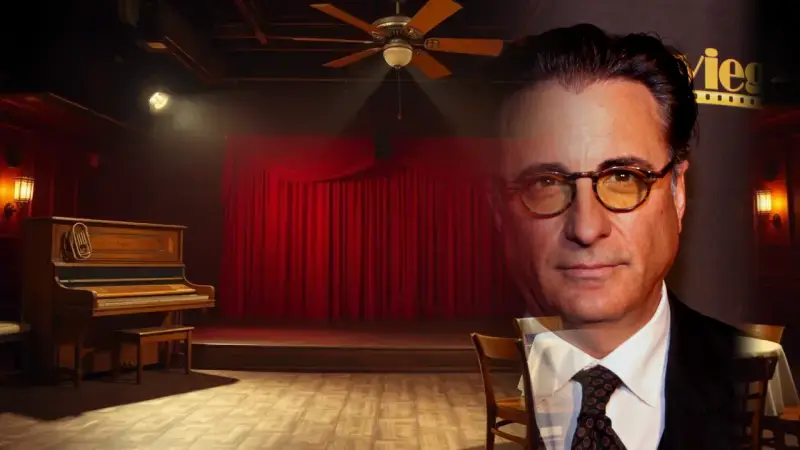
Header photo: Movieguide / Wikimedia Commons / CC BY-SA 2.0, modified: resized and blended with an AI-generated background. The person in the header is a real photo; only the background is AI-generated.