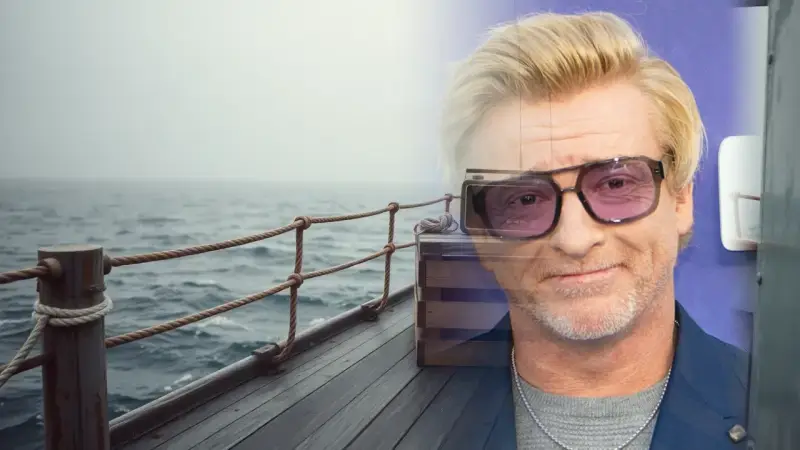
Rhys Darby as Angus “The Nut” Nutsford in The Boat That Rocked (2009)
On the crowded deck of Radio Rock, the fictional pirate station in Richard Curtis’s The Boat That Rocked (2009), one DJ is there mainly to make the others laugh. That is Angus “The Nut” Nutsford, played by New Zealand comedian Rhys Darby. The film is set in 1966, the same year the real Radio Hauraki sent a ship out to challenge the state’s grip on New Zealand radio. Darby gave the North Sea crew a Kiwi voice in that story.
The film was released in the UK on 1 April 2009. In North America it came out on 13 November 2009 as Pirate Radio, in a version cut from 135 minutes to 115, according to the Offshore Radio Museum.
Who Angus Nutsford is
Angus is one of the DJs on Radio Rock, an offshore station in the North Sea run by Quentin (Bill Nighy). The Shropshire Star described him as the ship’s fool. He belongs to an ensemble that includes Philip Seymour Hoffman as The Count, Nick Frost as Doctor Dave, Chris O’Dowd as Simple Simon, Tom Brooke as Thick Kevin and Rhys Ifans as Gavin.
Curtis wrote the film as a loose ensemble piece, not a story built around one hero. Angus is not a plot driver. He is a running source of comic energy, the broadcaster whose job is to be silly on air and off it. Screen Daily’s review complained that the DJs were one-note types, but that same clear-cut design is what gives a comic actor room to work in the gaps.
How Darby played it
The part is mostly physical and vocal. Angus is eager, a bit clumsy and always ready to be the butt of the crew’s jokes. Darby’s strengths are an elastic face, sound effects and a dry, flustered delivery, and the role leans on all of them without asking him to carry scenes alone.
He arrived on the film with a following from television. Deadline still introduces him as a Flight of the Conchords star, and that series had made him known as a deadpan comic foil. Yes Man (2008) had given him a Hollywood supporting part the year before. In The Boat That Rocked he was one voice among many in a very British cast, and he did not try to compete with the bigger names.
The world around the character
Curtis modeled Radio Rock on the British offshore stations of the 1960s, but the film is not an accurate account of them. The Offshore Radio Museum notes that much of the studio equipment on screen came from Radio Caroline’s original studios, and that Caroline staff advised the producers. Joanna Johnston was the costume designer, Danny Cohen the cinematographer and Mark Tildesley the production designer.
The soundtrack is the other main character. Screen Daily singled out its mix of late-1960s tracks, including the Small Faces, The Who and Jimi Hendrix, as the film’s saving grace.
Reception
Reviews were divided. Screen Daily was harsh at release, calling the film bloated and predicting trouble at the box office. Rotten Tomatoes currently shows 59 percent from 163 critic reviews. Other writers were warmer. The Prague Reporter praised the film’s affection for classic rock and pirate radio and called it cheerful and infectious.
Most of the criticism went at the film’s length, its looseness and its liberties with history, not at individual performances. The ensemble was generally treated as the film’s best asset, and Angus the Nut is part of what makes the crew feel like a gang.
What came next for Darby
The film sat in the middle of a long run of supporting comic roles. He later became widely known as Stede Bonnet in HBO’s Our Flag Means Death. In February 2026, Deadline reported that he had been cast as Arthur Tillbrook in the CBS pilot Regency, from writer Tara Hernandez. He toured North America with his stand-up show The Legend Returns in spring 2026. A CBR interview published on 3 September 2026 covered his return to Star Trek: Strange New Worlds for Season 4 as Trelane.
FAQ
Is Pirate Radio the same film as The Boat That Rocked?
Yes. Pirate Radio is the title used in North America, where the film was shortened to 115 minutes. The UK version runs 135 minutes.
Was Radio Rock a real station?
No. It is a fictional station modeled on 1960s British offshore stations such as Radio Caroline, and the film is not meant as an accurate portrait of them.
Who directed and wrote the film?
Richard Curtis wrote and directed it. Tim Bevan, Eric Fellner and Hilary Bevan Jones produced it for Working Title.
Header photo: Raph_PH / Wikimedia Commons / CC BY 2.0, modified: resized and blended with an AI-generated background. The person in the header is a real photo; only the background is AI-generated.