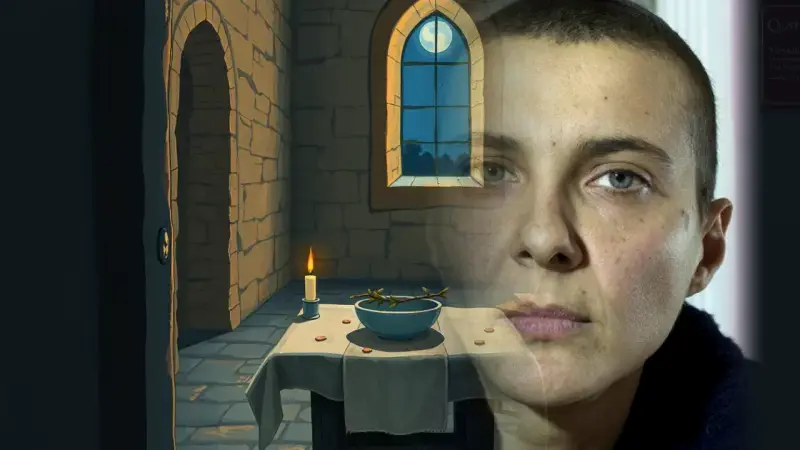
Rosalinda Celentano as Satan in The Passion of the Christ (2004)
The first face the audience of The Passion of the Christ meets after Jesus is not a Roman soldier or a high priest. In the blue-lit Garden of Gethsemane, a pale, hooded figure of unclear gender whispers that no one man can carry the weight of humanity’s sins. That figure is Satan, and the actress inside the cloak is Rosalinda Celentano, the Rome-born daughter of the singer-actor Adriano Celentano and Claudia Mori.
Mel Gibson’s 2004 film, which he directed and co-wrote with Benedict Fitzgerald, gave her the part that audiences worldwide still associate with her. It is a small role in running time, but a very visible one, and it came to a performer who had spent the previous fifteen years in Italian cinema.
Where she was before Gibson’s call
Celentano grew up inside Italian show business, and her own screen work began in the late 1980s. By the early 2000s she had a steady list of credits at home, including Il dolce rumore della vita (1999) and Paz! (2002), alongside Adored (2003). She had also appeared in The Order (2003), an English-language film. None of these made her a name outside Italy.
The part of Satan asked for something different from those roles. There was little dialogue to carry a performance and no conventional villainy to lean on. She had to be unsettling through stillness, gaze and presence.
A devil designed to look almost ordinary
Gibson did not want horns, red skin or a pitchfork. Critics who noticed the choice described a deliberately androgynous figure, and Gibson has explained the thinking in terms of temptation: evil, he suggested, is more dangerous when it looks nearly normal and nearly good, but not quite. A woman cast in a figure traditionally imagined as male was part of that design.
The voice was part of it too. In a 2004 interview, Celentano said the voice in the film was her own: she dubbed it in a deeper register, and the filmmakers then processed it with a harmonizer so that it could belong to a man, a woman, an old person, a young one or no one in particular.
The film’s dialogue is entirely in reconstructed Aramaic, Hebrew and Latin, so her lines reach the viewer through subtitles and sound as much as through words. That puts weight on how the voice is shaped and how she is framed.
The scenes that carry the role
Satan’s first scene is the Gethsemane temptation. A serpent slithers out from under the cloak toward Jesus, played by Jim Caviezel, who crushes its head, a deliberate visual echo of the Book of Genesis. Satan then seems to drift through the rest of the story, watching the trial and the scourging as an observer of human cruelty rather than a participant, an approach Gibson drew partly from the visions of the mystic Anne Catherine Emmerich.
The role ends in hell. When Jesus dies, Satan screams in defeat in a distorted, barren landscape, and the film cuts to the burial and the resurrection.
How the character was received
Reviews of the film were sharply divided; Rotten Tomatoes puts approval at 50 percent. The devil drew mixed notice within that. The Dallas Observer’s Robert Wilonsky wrote that the film’s demonic hallucinations looked like escapees from a David Lynch picture, while the Christian-audience guide Plugged In argued that the portrayal of Satan lifted events into the supernatural and widened the story beyond any single political or religious group.
Commercially the film was a phenomenon. Variety reports that it earned about $610 million worldwide against a $30 million budget, and that it was nominated for Oscars for makeup, cinematography and original score. Celentano’s Satan became one of its most recognizable images.
What the role changed, and what came next
Apple TV’s biography of her calls Satan the part she is “perhaps best known” for, and it remains the credit that introduces her to international audiences. She continued working in Italy afterward, with credits including Il nostro Messia (2008), Il ragioniere della mafia (2013) and Nati 2 volte (2019), and she is credited in more than twenty films in all.
The film itself has come back into view. It returned to theaters in a remastered edition in September 2026, ahead of Gibson’s two-part sequel, The Resurrection of the Christ. Lionsgate and Icon Productions have set Part One for May 6, 2027 and Part Two for May 25, 2028. Jaakko Ohtonen takes over from Caviezel as Jesus, and Mariela Garriga plays Mary Magdalene. For many viewers, Celentano’s cloaked figure in the garden remains the image the first film is remembered by.
Header photo: Alexandrov Dmitry / Wikimedia Commons / CC BY-SA 3.0, modified: resized and blended with an AI-generated background. The person in the header is a real photo; only the background is AI-generated.