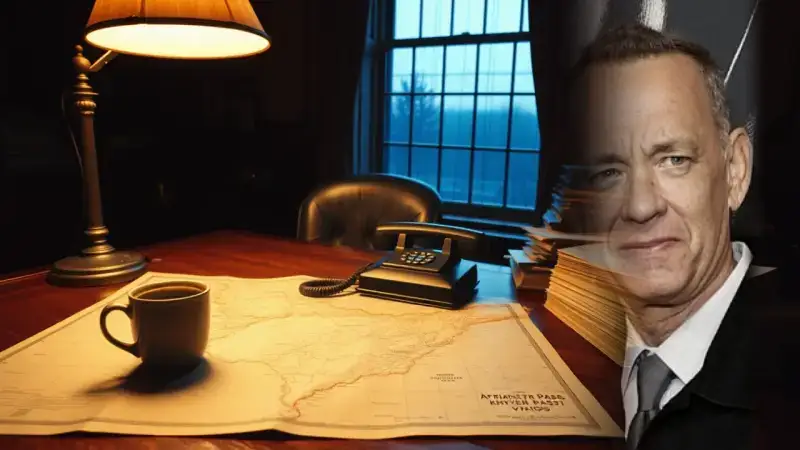
Tom Hanks as Congressman Charlie Wilson in Charlie Wilson’s War (2007)
In Charlie Wilson’s War (2007), Tom Hanks plays a Texas congressman whom everyone underestimates, including, for a long stretch, himself. Charlie Wilson is a Democrat from the state’s second district, nicknamed “Good Time Charlie.” The film follows him from a life of parties to a leading role in America’s covert support for the Afghan mujahideen in the 1980s.
The role is also where Hanks shares the screen with Om Puri, the Bollywood veteran who plays Pakistan’s President Zia ul-Haq. Their scene is one of the film’s sharpest, and it is the moment that turns Wilson from a bystander into a participant.
Who Charlie Wilson is
Mike Nichols directed the film from a screenplay by Aaron Sorkin, based on George Crile’s book. Hanks also produced it with his Playtone partner Gary Goetzman. The story opens with Wilson as a congressman known more for his taste for parties than for legislation. After he is named to the Defense Appropriations subcommittee in 1980, he learns that the covert budget for opposing the Soviets in Afghanistan is only $5 million. Charlie places a phone call and orders it doubled.
He is pushed further by Joanne Herring (Julia Roberts), a Houston socialite with strong anti-Communist convictions, and by Gust Avrakotos (Philip Seymour Hoffman), a blunt CIA operative. Amy Adams plays his assistant, Bonnie Bach, and Ned Beatty plays Doc Long, the chairman of the subcommittee. The plot matters here only as far as Charlie needs it. He is a man with influence, charm and a short attention span who finds something to care about.
How Hanks plays him
Hanks does not play Wilson as a crusader. He plays a back-slapping, joke-telling politician who is at ease in a room and never seems to be working hard. NPR’s review called Hanks “a blustering wonder.” Reelviews saw the shape of the performance as a change in Charlie’s nature, from a good ole boy to someone with a conscience. It added that audiences tend to side with a character when Hanks plays him, however questionable his ethics.
That goodwill is the role’s working tool. Sorkin’s script gives Wilson the one-liners and Hoffman’s Avrakotos the explosions. Hanks keeps the character light enough for the satire and grounded enough that the later turn lands. The Hollywood Reporter described the film as the anti-“Mr. Smith Goes to Washington”: a story where compromised, easily tempted men achieve something large.
The scene with President Zia
The Pakistan sequence is where the film’s tone shifts. Wilson visits Zia ul-Haq (Om Puri), and the Hollywood Reporter singled out the moment Charlie leaves the audience and mutters to Bonnie that he was told he had character flaws by a man who hanged his predecessor in a military coup. The line is typical of how the film makes its jokes land on the darkest facts.
Zia then shames him into visiting the refugee camps and hospitals on the Pakistan border. According to the Hollywood Reporter, what Wilson sees there overwhelms his sense of compassion and his desire to help the underdog. For the character, this is the turning point. For Hanks, it is a rare stretch of the film where he plays quiet.
Puri, who had worked with Nichols before on Wolf (1994), has said he first refused the part because it was so brief. He said Nichols insisted, and that he prepared fully for his two scenes, watching footage of Zia. Even with so little screen time, the role became one of the best-remembered of his international career.
Reception and the role’s place
Critics responded to the film’s speed and wit. Reelviews praised its rapid pace and smart screenplay, and ranked it tenth on its list of the best films of 2007. It noted that the film’s Taliban-era aftermath casts a long shadow, a point the film’s closing stretch makes through Wilson’s own frustration. Reelviews also pointed to James Newton-Howard’s score, which borrows a chorus from Handel’s Messiah for ironic effect. Hoffman drew much of the attention as the standout, which left Hanks to anchor the film instead of dominating it. That was the point of the casting: a reliable, likable lead whose charm makes the central irony sting.
Hanks since
Hanks has stayed busy. He voiced Woody again in Toy Story 5, which opened in the United States on June 19, 2026. Variety reported in February 2026 that he was set to star as Abraham Lincoln in a film adaptation of George Saunders’s Lincoln in the Bardo, directed by Duke Johnson. Charlie Wilson remains one of his most dryly comic character parts, a politician who proves more serious than anyone expected.
Header photo: Eva Rinaldi / Wikimedia Commons / CC BY-SA 2.0, modified: resized and blended with an AI-generated background. The person in the header is a real photo; only the background is AI-generated.